
Duodoku - Rules & Guide
What is Duodoku?
Ghost Sudoku is a variation of two complete 9x9 standard Sudoku boards overlapping each other. As can be seen from the example picture, one disk is represented by a black solid line, and the other disk is represented by a blue dotted line, and the two produce a row and a column of misaligned overlap. This deep overlap not only retains the fun of classic Sudoku, but also brings an extremely strict double bind.
Basic rules
- Double Standard Rule: Both the solid line board and the dotted line board are each a complete Sudoku. You need to fill in all the spaces with numbers 1 to 9 so that each number appears exactly once in each row, column and 3x3 grid within the respective 9x9 range.
- Double identity of overlapping areas: A grid in the overlapping area of two boards (up to an 8x8 area) belongs to two Sudokus at the same time. The numbers you fill in mustsatisfy both the rows and grid requirements of the solid line disk and the dotted line disk.
- Sharing and interoperability: The numbers in the overlapping area are shared by the two disks. This is a bridge connecting the logic of the two disks. The derivation results of one side will directly limit and affect the other side.
How to solve problems and practical skills
Tip 1: Find breakthroughs from non-overlapping edges
Although overlapping areas make up the majority, non-overlapping edge areas (i.e., the L-shaped periphery limited only by a single disk surface) are often excellent entry points. Because the constraints of the edge grid are relatively few and intuitive, after the number is determined, the clue can be quickly "pushed" into the overlapping area.
Tip 2: Use misplaced grids for cross elimination
This is the core technique of ghosting Sudoku. Due to the misalignment and overlap of the two disks, a 3x3 grid on the solid-line disk often spans multiple grids on the dotted-line disk. When you determine a number in a certain square on the solid line disk, it not only excludes the relevant areas on the solid line disk, but can also use its physical position to perform powerful "cross-border exclusion" on the squares on the dotted line disk.
Tip 3: Merge two candidate data sets
In the overlapping area, each square has two identities at the same time (for example: it is row 2 of the black disk and row 1 of the blue disk). When you are considering candidates for a certain grid, be sure to intersect its restrictions on the black board with the restrictions on the blue board. This kind of double pressure can often directly help you squeeze out the only solution.
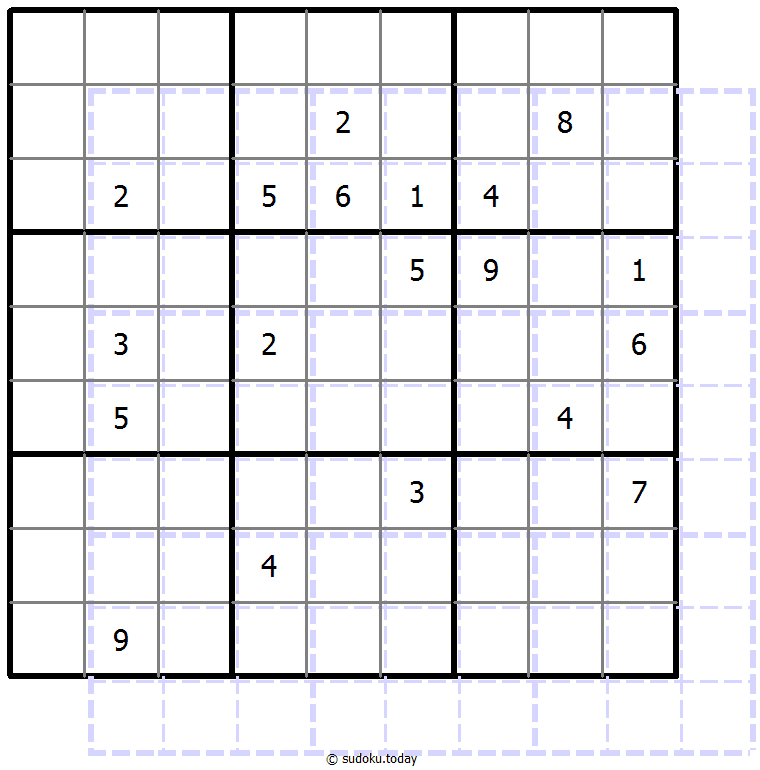
Example image: The depth of the solid line and the dotted line are overlapping
Frequently Asked Questions (FAQ)
Q: Which Sudoku does the number in the overlapping area count as?
A: Counted as two Sudokus at the same time! The number you fill in the overlapping area must ensure that it does not violate the rules in the black solid line Sudoku, and it does not violate the rules in the blue dotted line Sudoku. It can be said to be "one fish, two meals".
Q: Can these two Sudokus be solved separately?
A: Absolutely not. Since the overlapping area is very large (8x8), it is far from enough to look at any one disk alone with known conditions. They must be regarded as a whole, and the double constraints of mutual transmission and superimposition between the two can be used to solve the puzzle smoothly.
Play Duodoku
Browse all puzzles or start with this sample puzzle.
English | 中文(简体) | 中文(繁體) | 日本語 | 한국어 | Français | Deutsch | Español | Português | Русский | Italiano | Nederlands | Türkçe | हिन्दी | ไทย | Tiếng Việt | Bahasa Indonesia | Polski | Українська |
数独 | Cool Sudoku | 数独 | Sudoku Puzzle | 賢くなるパズル | Free Printable Sudoku Puzzles
© sudoku.today All rights reserved 2019-2026