
Neighbourship Sudoku - Rules & Guide
What is Neighborship Sudoku?
Neighborship Sudoku adds special grids with square and circular frames to the board. These graphic grids not only need to be filled in with numbers 1-9 normally, but the numbers they fill in also represent the number of non-repeating numbers in their "neighbor" grids, which requires you to have strong spatial counting skills.
Basic rules
- Standard Sudoku Rules: Fill in each empty square from 1 to 9 so that each number appears exactly once in each row, column and 3x3 square.
- Square cell (four diagonal corners): The number filled in the square cell indicates how many different numbers are contained in the cells (up to 4) adjacent to it diagonally.
- Circular cell (eight cells around): The number filled in the circular cell indicates how many different numbers are contained in all the adjacent cells (including top, bottom, left, right and diagonal lines) around it.
How to solve problems and practical skills
Tip 1: Pay attention to physical limitations on edges and corners
The number of "neighbors" of a graphic grid located at the edge or corner of the disk is inherently limited! For example, a circular grid in a corner has only 3 neighbors around it, so the number filled in it can never be greater than 3 (only 1, 2 or 3 can be filled in). If it is a square grid close to the edge and it has only 2 diagonal neighbors, then the number inside can only be 1 or 2! Exploiting physical boundaries can greatly narrow down the number of candidates.
Tip 2: Find the "full" state (extreme value reasoning)
If you see a square in the middle of the board that says 4, that means its 4 diagonal neighbors must all be different numbers. What is more lethal is the edge lattice. For example, the circular lattice on the right edge in the example picture gives hint 5, and it happens to have only 5 neighbors on the edge, which means that all 5 of its neighbors must be different from each other! This full status creates strong exclusivity.
Tip 3: Use the numbers in the shape itself
Don’t forget that the square and circular grids themselves are part of Sudoku. If in reasoning you find that the four diagonal neighbors of a square have only 2 different numbers, then the square itself must be filled with 2. On the other hand, if when deriving other rules it is discovered that the square grid cannot be filled with 2, then it is absolutely impossible for its diagonal neighbor to have only 2 different numbers. This forms a reverse logical lock.
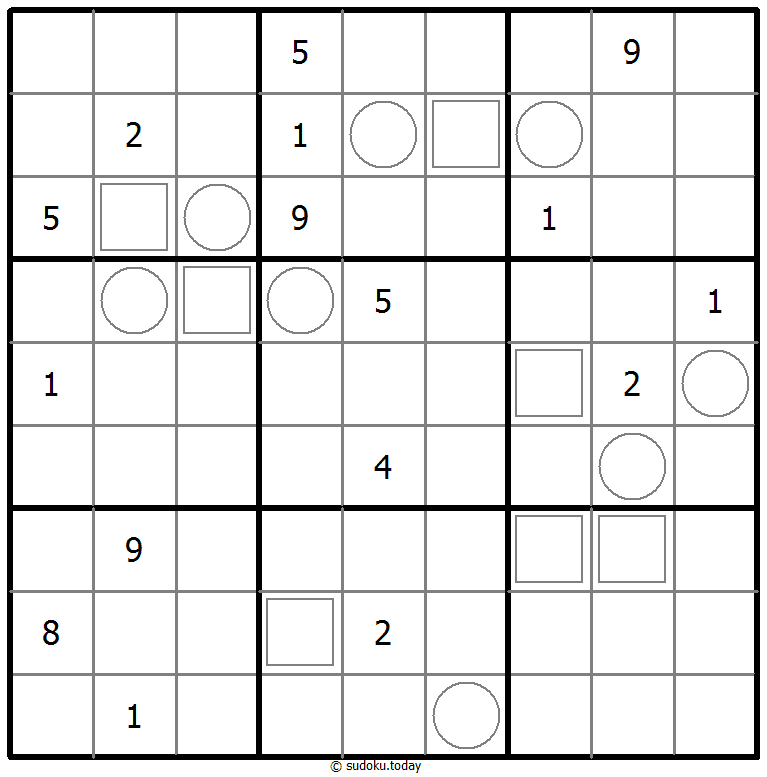
Example image: special grid containing circular and square statistical conditions
Frequently Asked Questions (FAQ)
Q: What exactly does "how many different numbers" mean?
A: Assume that the four diagonal neighbors of a square grid are eventually filled with numbers 1, 3, 1, and 4 respectively. There are a total of 3 different numbers 1, 3 and 4. Therefore, the number 3 must be filled in this square grid.
Q: If there are no numbers in the graphic grid, am I also responsible for filling it in correctly?
A: Yes! This is also the greatest fun of Neighborhood Sudoku. Whether it is a graphical grid with pre-given hint numbers or an empty graphical grid, as long as it has an outer frame, the number you finally fill in the grid must perfectly fit the statistical results of non-repeating numbers in its surrounding neighbors.
Play Neighbourship Sudoku
Browse all puzzles or start with this sample puzzle.
English | 中文(简体) | 中文(繁體) | 日本語 | 한국어 | Français | Deutsch | Español | Português | Русский | Italiano | Nederlands | Türkçe | हिन्दी | ไทย | Tiếng Việt | Bahasa Indonesia | Polski | Українська |
数独 | Cool Sudoku | 数独 | Sudoku Puzzle | 賢くなるパズル | Free Printable Sudoku Puzzles
© sudoku.today All rights reserved 2019-2026