
Point To Next Sudoku - Rules & Guide
What is Point to Next Sudoku?
Point to Next Sudoku adds arrows to a standard Sudoku grid. If a cell with an arrow contains the digit n, then the digit n+1 must appear somewhere in the direction pointed to by that arrow.
Basic Rules
- Standard Sudoku rules: Place digits 1 to 9 so that every row, column, and 3x3 box contains each digit exactly once.
- Find n+1: If an arrow cell contains n, then n+1 must appear in a cell along the arrow's line of sight.
- Line of sight: The target cell may be adjacent to the arrow cell or farther away, as long as it lies on the straight line indicated by the arrow before the edge of the grid.
How to Solve Point to Next Sudoku
Tip 1: Arrow cells cannot contain 9
If an arrow cell contained 9, it would require a 10 in the arrow's direction. Since Sudoku uses only digits 1 to 9, every arrow cell can immediately eliminate 9.
Tip 2: Use short arrows first
If an arrow points toward only one remaining cell before the edge of the grid, the rule becomes direct: that one target cell must contain n+1. These short arrows often provide fast progress.
Tip 3: Combine arrows with normal elimination
When an arrow has several possible target cells, use row, column, and box restrictions to decide where n+1 can go. For example, if the arrow cell is 4, then a 5 must appear somewhere on the arrow's line of sight.
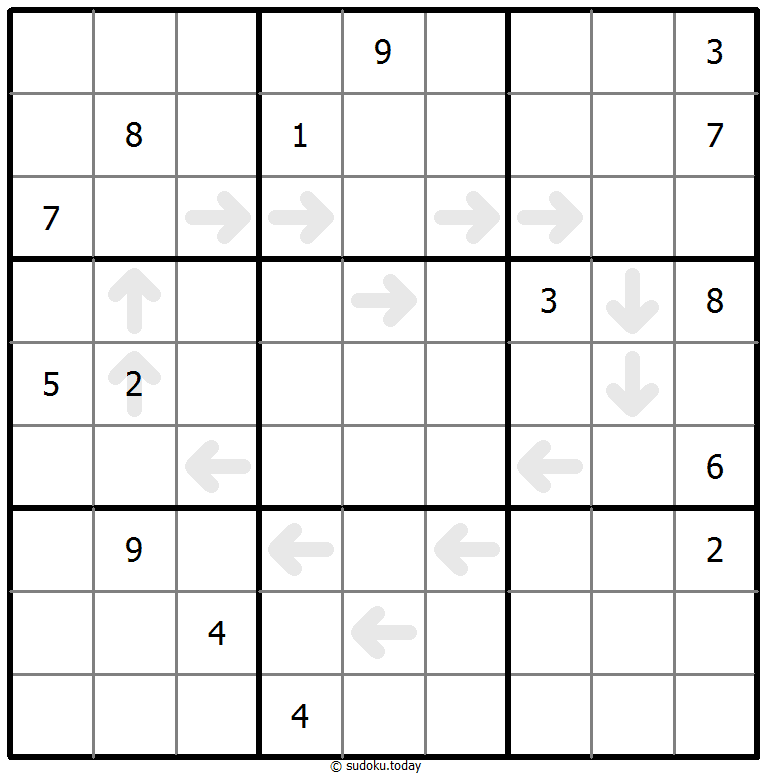
Example: follow each arrow to find where n+1 can be placed.
Frequently Asked Questions
Q: Does n+1 have to be next to the arrow cell?
A: No. The digit n+1 can be anywhere along the arrow's line of sight. It must be adjacent only when the arrow points to exactly one available cell before the edge of the grid.
Q: If I see a 5 along an arrow, must the arrow cell be 4?
A: Not necessarily. The rule works from the arrow cell outward. A 4 in the arrow cell requires a 5 in the arrow's direction, but a visible 5 along that line does not prove that the arrow cell is 4.
Play Point To Next Sudoku
Browse all puzzles or start with this sample puzzle.
English | 中文(简体) | 中文(繁體) | 日本語 | 한국어 | Français | Deutsch | Español | Português | Русский | Italiano | Nederlands | Türkçe | हिन्दी | ไทย | Tiếng Việt | Bahasa Indonesia | Polski | Українська |
数独 | Cool Sudoku | 数独 | Sudoku Puzzle | 賢くなるパズル | Free Printable Sudoku Puzzles
© sudoku.today All rights reserved 2019-2026