
Windoku - Rules & Guide
What is Windoku?
Windoku, also called Window Sudoku or Hyper Sudoku, adds four extra 3x3 regions to a standard Sudoku grid. These shaded regions act like additional boxes, giving the puzzle more constraints than classic Sudoku.
Basic Rules
- Standard Sudoku rules: Place digits 1 to 9 so that every row, column, and 3x3 box contains each digit exactly once.
- Four extra windows: Each shaded 3x3 window must also contain the digits 1 to 9 exactly once.
- Overlapping constraints: A cell inside a window still belongs to its normal row, column, and standard 3x3 box, so all relevant constraints apply at the same time.
How to Solve Windoku
Tip 1: Scan the shaded windows early
The four extra windows often have fewer candidates because they overlap with normal rows, columns, and boxes. Treat them as additional Sudoku houses when placing or eliminating digits.
Tip 2: Use overlapping houses
When a cell lies inside a shaded window, check both its standard 3x3 box and its window. A digit already present in either region cannot appear in that cell.
Tip 3: Compare window positions
The four windows have fixed positions. Their overlap with the standard boxes creates repeated patterns that can reveal hidden singles and locked candidates.
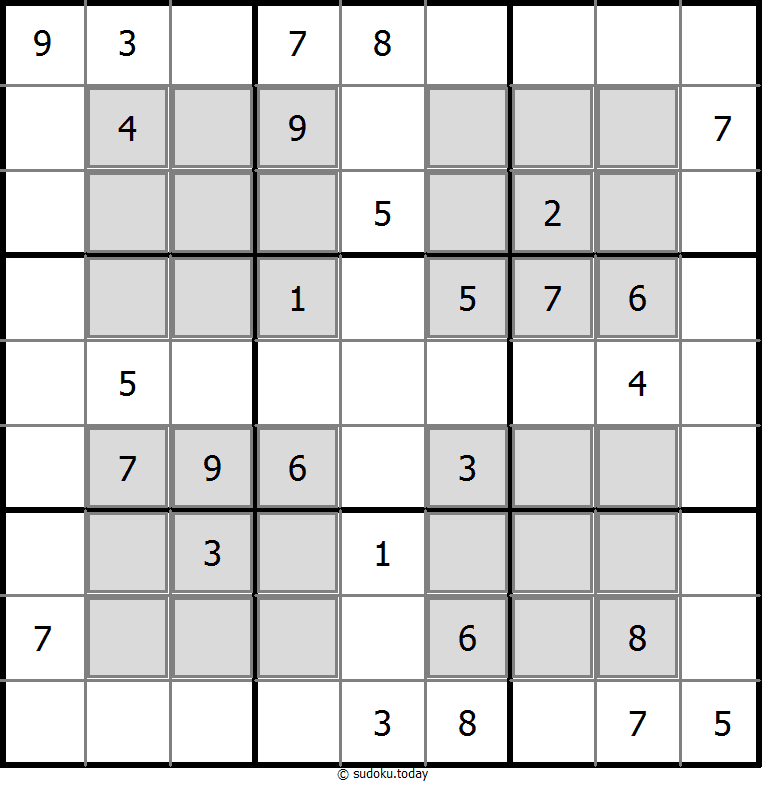
Example: the shaded 3x3 windows add four extra Sudoku houses.
Frequently Asked Questions
Q: Do shaded cells still follow normal Sudoku rules?
A: Yes. A shaded cell must satisfy its row, column, standard 3x3 box, and shaded window at the same time.
Q: Are the four windows always in the same places?
A: In standard Windoku, yes. The windows are the 3x3 regions at rows 2-4 and columns 2-4, rows 2-4 and columns 6-8, rows 6-8 and columns 2-4, and rows 6-8 and columns 6-8.
Play Windoku
Browse all puzzles or start with this sample puzzle.
English | 中文(简体) | 中文(繁體) | 日本語 | 한국어 | Français | Deutsch | Español | Português | Русский | Italiano | Nederlands | Türkçe | हिन्दी | ไทย | Tiếng Việt | Bahasa Indonesia | Polski | Українська |
数独 | Cool Sudoku | 数独 | Sudoku Puzzle | 賢くなるパズル | Free Printable Sudoku Puzzles
© sudoku.today All rights reserved 2019-2026